






For a general manager, a hotel refurbishment can pose a threat to the smooth running of the building. There’s pressure to improve the asset, upgrade the offering for guests, increase efficiency and justify stronger room rates.
For the design team, the challenge is about choosing a partner who can work inside a live, revenue-generating environment without letting cost, programme or disruption escalate.
That’s why the most important part of a hotel fit-out often happens before site mobilisation.
In live hotels, poor planning will impact the guest experience
When a hotel stays open during refurbishment, there is very little room for error.
A delay is not just a delay. It can affect room availability, operational planning, staff workload and the confidence of the management team. A poorly coordinated sequence can mean noise in the wrong place, access conflicts, last-minute changes, frustrated stakeholders and pressure on revenue.
The contractor needs to understand how the building operates, how guests move through it, where pressure points sit, and what level of disruption the hotel team can realistically absorb.
The real work starts before the site opens
In the weeks before works begin, the critical questions need to be answered:
- What items have long lead times?
- Are layouts, finishes and services fully coordinated?
- Has the phasing been planned around hotel operations?
- Are noisy or disruptive works matched to suitable windows?
- Does the client team have a realistic picture of risk before the contract is live?
If those questions are left unresolved, the project team ends up reacting on site instead of providing leadership before work starts on site.
As Paul Grant puts it:
“At least four weeks in advance of starting on site, we have internal planning meetings with the design team, the consultants, the architect and the client. We show a clear programme of what’s going to happen across the first two months on site and all the different streams that play into that. Design issues are flagged early. A lot of that gets handled before we ever get to site.”
What’s happening above the ceiling?
Lighting, sprinklers, acoustic treatments, feature ceilings, air-conditioning, containment and access requirements all compete for the same space. If that coordination is not resolved early, the clash does not disappear. It simply reappears on site, where the cost of fixing it is higher and the impact on programme is more serious.
A drawing package may look advanced enough to proceed, but if architectural intent, M&E requirements and finish details are not properly interrogated together, the programme carries hidden risk from the outset.
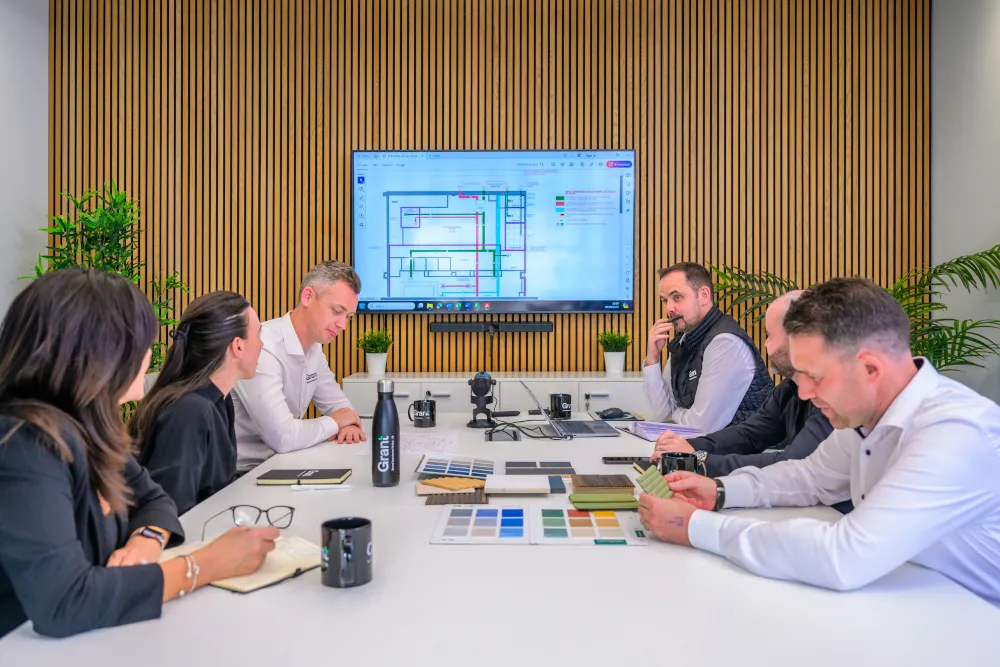
Strong hotel refurbishment planning means looking at those elements together, not in isolation. It means working through constrained areas in detail before trades arrive. It means making sure approvals, RFIs and technical submissions are not scattered across email trails, but logged and tracked in one place so the whole team is working from the same information.
That level of coordination does not just protect the build. It protects the operator from unpleasant surprises.
Live projects need agility, not rigid sequencing
Even the best-planned live environment will shift.
Access changes. Deliveries move. Part of the building becomes available earlier than expected. Another area becomes more sensitive because occupancy spikes or hotel priorities change. The programme cannot be so rigid that it breaks under pressure.
On a recent large fit-out project, a bespoke terrazzo tile carried a twelve-week lead time. Rather than lose momentum of the programme, the sequencing was reorganised so that fire walls, internal lining and high-level containment works moved ahead during the waiting period. Mechanical works were then split into phases so progress could continue in parallel.
The result was not just a recovered programme. It was a project team staying in control because they were willing to rethink the sequence instead of blindly following the original plan.
As Paul Grant says:
“It’s not always about giving alternatives, sometimes you have to be agile and move things around. Not do it how it’s always been done. We came back with a revised programme, looked at it over a couple of hours, and said yeah, we can make this work.”
That mindset matters in hotels. The contractor has to be disciplined enough to plan properly, but agile enough to change if live conditions change.
Communication is not a soft skill on a hotel project
Poor communication is frequently the cause of hotel general managers perceiving a project as disruptive.
They do not need to know every technical detail but they do need to know what is happening, what is changing, when noise or access issues are likely, and whether anything needs to be managed operationally before it becomes a problem.
Poor communication creates doubt and damages trust.
That’s why the relationship between the site team and the hotel management team is so important. On live projects, communication cannot be reduced to a formal progress meeting once a week. It needs to be active, practical and human.
On a recent Dublin hotel refurbishment, our site manager met the general manager on site every week and stayed in regular contact as the works progressed. Potential issues were flagged early. Access arrangements were discussed in advance. Noise and timing were managed through conversation, not confrontation.
Paul Grant puts it simply:
“It’s a big deal building that personal relationship between the person on the ground on our side and the general manager. Having a team on site who are willing to engage with the client, go up the stairs and say ‘there’s going to be noise here’ or ‘can we work at these times?’, that’s what makes the difference in a live hotel.”
What hotel operators and managers really need.
They need confidence that the contractor understands what is at risk in a live hotel.
They are buying:
- a programme built around operational reality
- early identification of long-lead and coordination risks
- sequencing that protects revenue and guest experience
- clear communication with the hotel team
- a partner who can adapt when conditions change
In other words, they are buying the thinking behind the delivery.
Because in hotel refurbishment, the job is not just to complete the works. It is to improve the asset without destabilising the business that keeps it alive.