







Investing in the right digital foundations changes the way every project starts - and runs.
A Knowledge Transfer Partnership is a formal collaboration between a business and an academic institution, with a dedicated graduate embedded in the company for up to two years. KTPs are not common in the fit-out sector. We entered into one with Southern Regional College in Newry to answer a specific question: What changes when project information is treated as a core asset, not a by‑product of delivery?
That process produced our Common Data Environment, our dashboard framework, and our alignment to the ISO 19650 standard. It also changed how we think about what it means to be ready to start and handover a project.
Building a system that finds gaps early.
At a glance most projects seem to have all the information required to start construction. The drawings, programme and the scope is agreed. But it's important that all information is thoroughly reviewed, tested, and that any risks are highlighted. This reduces the risk of any problems occurring on site at the point when they're hardest to deal with.
What we've learned over time is that coordination gaps, wrong revisions and long-lead items that weren't flagged can almost always be prevented in the weeks before mobilisation. Experience tells you where to look for them and the software and workflows implemented during the KTP help find these issues consistently, on every project.
“If we’re starting on site next week and we haven’t received the construction drawings, that’s already showing up red flags. On a six-week programme there’s no room for movement in those dates.” - Jack Murtagh, BIM & Design Co-Ordination Manager
On a recent project, the full set of construction documents had been uploaded and on time which seemed like a good start to the project. But when the team sat down and did a quality check and reviewed them properly, it was clear they were the wrong revisions and didn’t line up with the existing layout. That early review, before a single trade was on site, is exactly what the system is designed to catch.
“It felt small at the start, but the lack of planning caught up with us.” - Cathal Grant, CEO
What ISO 19650 means in practice.
ISO 19650 is an increasingly important standard that informed organisations follow, and it is now often becoming a requirement for inclusion on tender lists. The KTP gave us the time and rigour to build a system that would comply with ISO 19650, not only to get the certification but to make it genuinely work for the way we run projects.
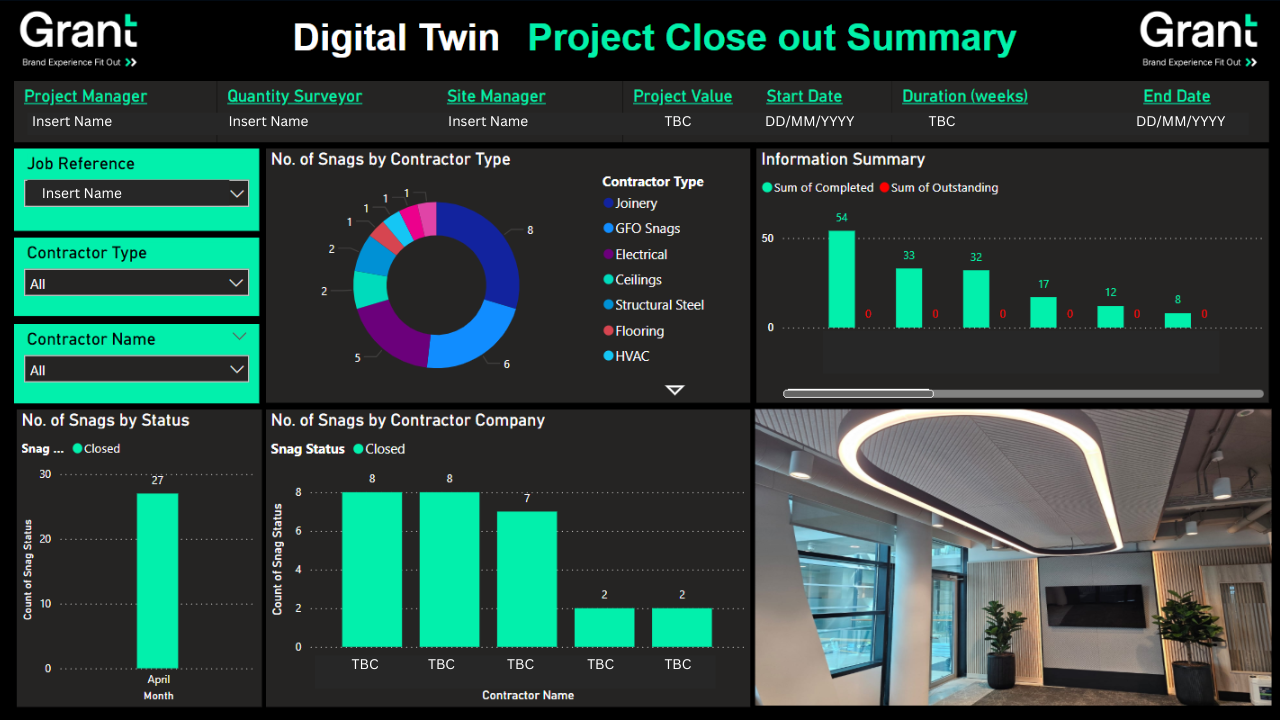
The CDE we built is where every drawing, technical submittal, RFI and specification now lives for every active project. Subcontractors are invited in from the moment they’re appointed. The design team reviews and approves through the same system. Everyone works from one agreed source of information.
“If we’re involved early, we can get the design team properly aligned. Drawings are reviewed together, clashes are picked up, and what’s on paper is checked against what actually exists.” - Jack Murtagh, BIM & Design Co-Ordination Manager
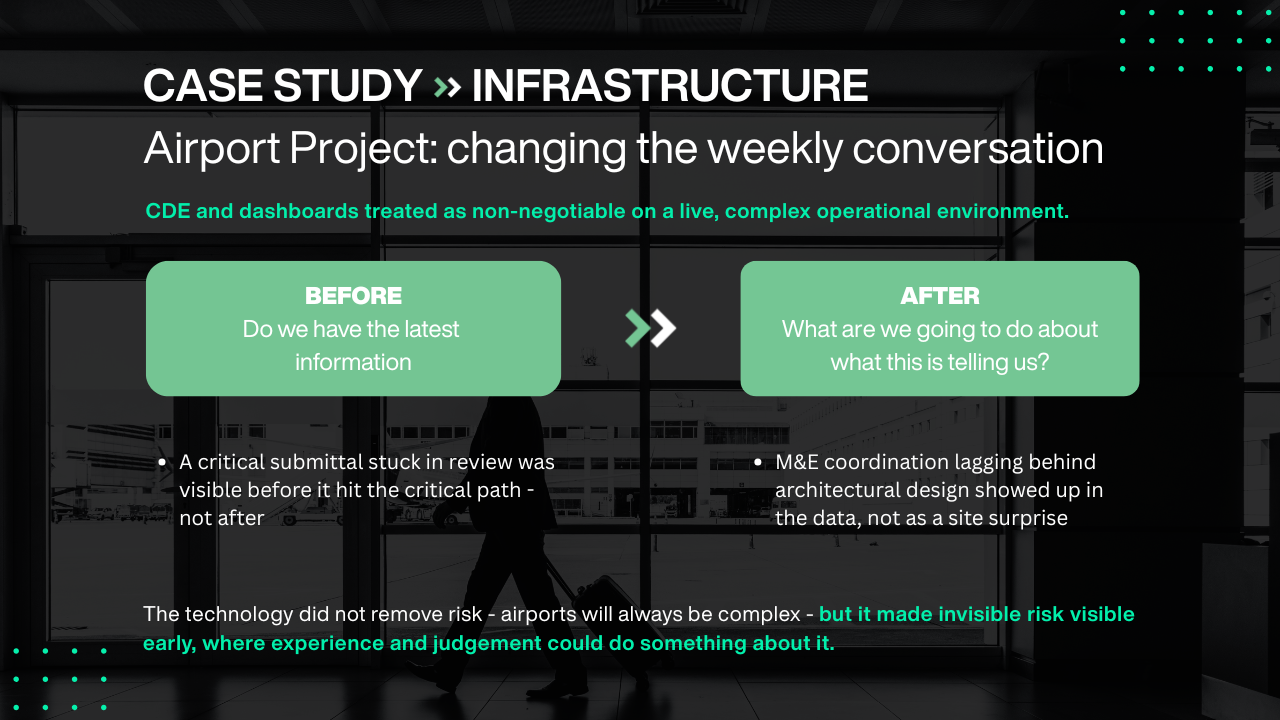
The whole point of the system is to highlight issues while they’re still lines on a drawing or an item in a register, at the stage when fixing them is straightforward.
A lot of companies have ISO accreditation. It's not just about acquiring the standard, it's about building the culture around it, the weekly discipline of reviewing dashboards together, making sure information doesn’t drift back into email threads the moment the pressure comes on.
Plan the work. Work the plan.
Investment in digital technology comes down to one thing; having robust, reliable information before we start working on site. That information must accurately reflect what actually exists, so coordination issues can be identified and resolved early saving time, cost, and frustration. This is where the use of digital technology delivers real value.
On larger projects a Matterport/Point cloud survey is completed as soon as we get access. This ensures any legacy survey information is accurate. On a large leisure and entertainment fit-out in Dublin, the legacy survey information showed structural columns in different positions to where they were on site. Early discovery of this avoided the need to amend work on site.
“It’s the likes of those items that we need to catch really early, before the joinery units start being made. If they get on site and they don’t fit as they’re supposed to, that costs a lot of money. But it also costs a lot of time. And that leads to a delayed opening.” - Jack Murtagh, BIM & Design Co-Ordination Manager
When the client asks for it by name.
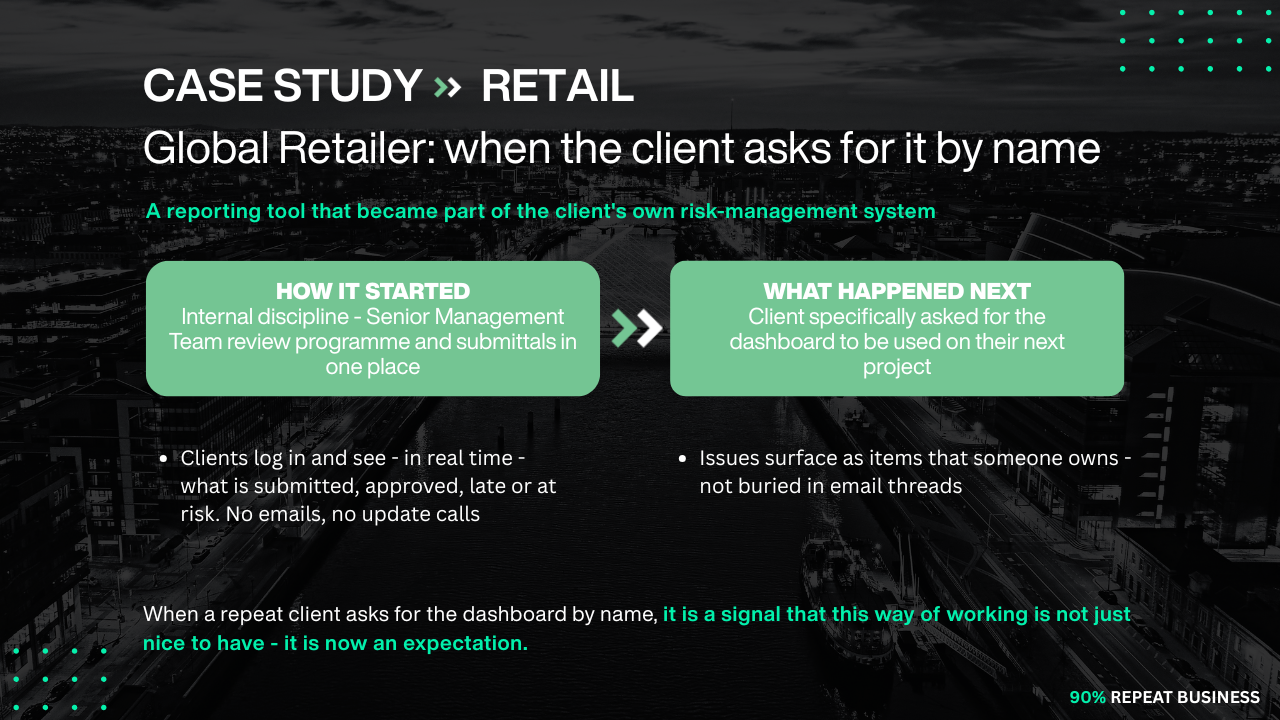
In the early stages of working on fit-out projects for repeat clients we introduced dashboards to track the key information that really matters. The dashboards started as an internal tool, a way for the senior team to review programme, design, technical submittals and site issues in one place each week. When it came down to critical deadlines on a project we would use these in our client meetings. By the time the next project came around the client specifically asked us to run all jobs through the dashboards.
For the client, the value was straightforward. They logged in and saw, in real time, what was submitted, what was approved, what was late and what was at risk. One source of truth, available to everyone building trust through complete transparency.
“If they want to see the status of technical submittals, they go in and look through the statuses, what’s been approved, what’s outstanding. They don’t have to email anyone. The answer is just there.” - Jack Murtagh, BIM & Design Co-Ordination Manager
A question worth asking early
Before a fit-out begins, it’s worth asking: does everyone involved actually have the clarity and training required to do their job well from day one?
Looking back, the projects that have gone well were set up properly from the start. Everyone has been made aware of the processes to follow and additional training has been given where required. All the information requirements are clear and set out for everyone to follow. Long-lead items have been identified and ordered. When the answer to that question is genuinely yes, the project has a very different character.
Information becomes easier to manage, with a clear and consistent process from initial upload and approval through to final handover. That clarity tends to hold throughout the life of the project - all the way to completion.
Start the conversation HERE
About the author:
Jack leads BIM coordination and digital project management at Grant Fit Out. He built the company’s Common Data Environment and dashboard reporting system through a Knowledge Transfer Partnership with Southern Regional College in Newry, and developed the ISO 19650-aligned workflows that underpin how the team manages information across commercial, hospitality and infrastructure projects, including work at Airports and across schools programmes throughout the UK and Ireland.