





Comparing contractors based on price feels reassuring at tender stage.
In fit-out projects, the environments are live, the programmes are tight, the budgets are strict, and cost becomes the easiest way to compare tenders because it can be measured, compared and circulated easily across a project team. But value-add and cost certainty are the metrics that really matter.
Information gaps, coordination issues and late decisions tend to surface gradually, often after the contract has been awarded and momentum is already under pressure.
“We see it all the time. Price feels like certainty early on, but it doesn’t always deliver it once work starts.” Jack Murtagh, BIM & Design Co-Ordination Manager
Early choices shape what happens once work begins. Programme certainty, coordination, sequencing and decision-making are influenced long before the site is live, but their impact only becomes visible later, when adjustments are more expensive.
Stepping away from the race to the bottom.
Lowest price depends on assumptions holding, information being complete, and coordination being simpler than it appears at tender stage. When those assumptions don’t hold, the cost reappears elsewhere.
“The cheapest price is often the dearest price.” Damien Quinn, Project Manager, Grant Fit Out
Projects driven primarily by price tend to encounter pressure as they progress. Time allowances tighten, technical input arrives later than ideal, and decisions become reactive rather than planned.
Where cost-led decisions show up later.
When early decisions are framed mainly around cost, the consequences usually take time to show up once the project is live.
Design or information gaps become site issues. Decisions slow down as groundwork is still being done. Programme pressure builds through variations, rework, clarification and late changes. This creates a bottleneck and affects programme and cost.
Many of the issues that slow projects down begin as small assumptions. Drawings are taken at face value. Information is expected to line up. Furniture layouts and M&E coordination are treated as separate problems. When your fit out contractor is involved early, they’ll question those assumptions while there is still room to do something about them.
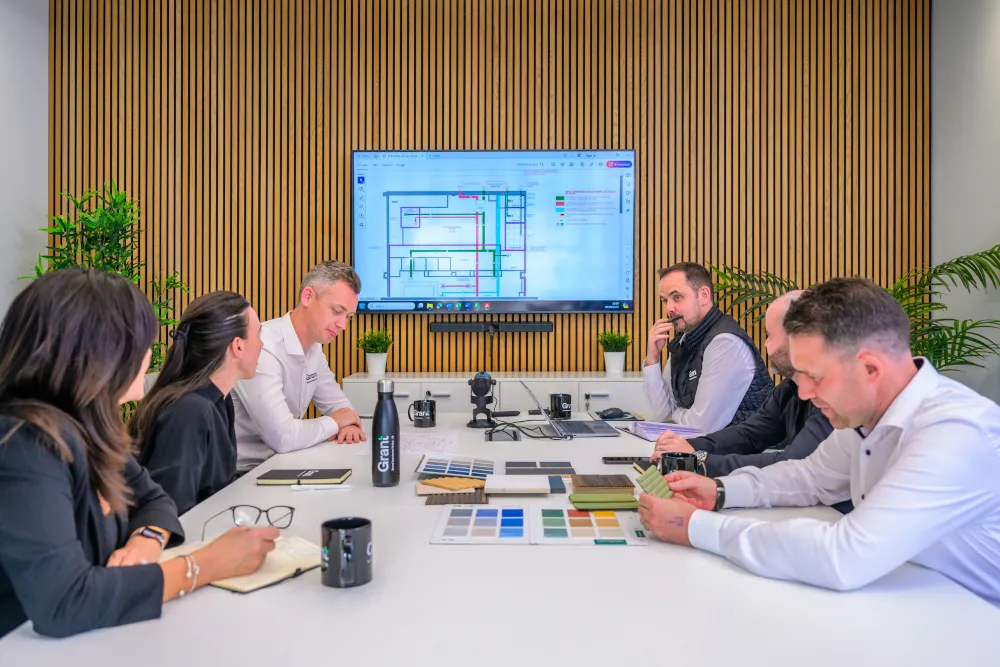
“If we’re involved early, we can get the design team properly aligned. Drawings are reviewed together, clashes are picked up, and what’s on paper is checked against what actually exists.” Jack Murtagh, BIM & Design Co-Ordination Manager
That early coordination changes where problems appear. Instead of surfacing on site, issues are resolved in design. Existing conditions are verified through surveys rather than trusted blindly. Details are worked through at room level before they become live questions.
“Things like room data sheets sound small, but that’s where a lot of issues hide. Socket heights, joinery, furniture. If that isn’t coordinated early, you’re answering questions later under pressure.” Damien Quinn, Project Manager, Grant Fit Out
That work doesn’t remove complexity, but it stops it from showing up at the most expensive moment, when time is tight, options are limited, and the programme is already under strain.
Cost versus Outcomes
Projects that run well are rarely defined by having the lowest starting figure. They are the ones that were set up properly.
Time spent early understanding constraints, sequencing, lead times and coordination requirements changes how a project behaves once work begins. Decisions are made earlier. Issues surface while options still exist.
“When you invest time upfront, you’re buying clarity. And clarity changes how a project behaves once it’s live.” Jack Murtagh, BIM & Design Co-Ordination Manager
That clarity brings predictability. Predictability reduces friction. And friction, more than cost alone, determines how smoothly a project is delivered and this is where cost certainty comes from.
To see more of our recent projects click HERE